
I completely get the rush.
You drop a quick prompt into an interface, and suddenly an entire marketing campaign or slide deck bleeds onto your screen.
It feels ridiculously fast. It feels incredibly productive.
But let’s address the elephant in the room: are you actually building something that lasts, or are you just playing with a highly sophisticated, shiny new toy?
The ecosystem is moving at a breakneck pace.
A new model drops on a Tuesday, and by Thursday, ten different software wrappers exist for it, pushed by people promising you can replace your income from the couch.
We are treating these algorithms like magic money-printing boxes.
But a clever prompt doesn’t replace the heavy lifting required to make consumers trust your brand or pull out their credit cards.
We are stuck in a loop of testing beta features instead of building real systems.
The Reality Behind the Wealth Narrative
If you scroll through your feed, you inevitably see posts shouting about someone making ten grand a month with a chatbot.
I don’t want to drag anyone down or dismiss their hustle.
But when you peel back the layers on how people are actually generating this money, you usually find a few distinct patterns.
First, you have creators who already possessed a massive, engaged following.
They launch a mediocre generation tool, and their pre-existing audience buys it.
The software didn’t generate the wealth; their established trust and distribution channel did.
Second, there are the folks selling the shovels.
Just like the gold rush, the prospectors often go broke, but the merchants selling the pickaxes rake in cash.
Today, those pickaxes are “exclusive prompt libraries” and online courses aimed at people looking for a shortcut.
Then you have the legacy winners. These are businesses that were already highly successful.
They integrate a small automation feature, get a standard productivity bump, and credit their entire quarter to the new tech.
If you strip away the hype, the math gets exceptionally bleak.
A recent MIT report tracked $30 to $40 billion dumped into enterprise AI, yet a staggering 95% of those initiatives failed to deliver any measurable return on investment.
Let’s look at how the actual numbers break down when companies try to force these tools into their workflows without a solid foundation:
| Enterprise Integration Attempt | Average Capital Burn | Measurable ROI Achieved | Primary Bottleneck Killing the Project |
|---|---|---|---|
| Internal Knowledge Chatbots | $1.2M – $3M | < 4% | Employee abandonment after failed queries |
| Automated Content Engines | $400k – $800k | 12% | Brand degradation, manual human rewrite costs |
| Predictive Sales Modeling | $2.5M+ | 6% | Disconnected data silos, hallucinated projections |
| Custom Software Wrappers | $50k – $150k | 2% | Instantly replaced by native vendor updates |
The massive tech conglomerates are making billions selling the infrastructure.
At the same time, the solo developers and mid-level operators looking at these exact numbers are still struggling to prove actual, sustainable revenue bumps.
The 90/10 Nightmare
Here is where the frustration really sets in.
There is a fundamental misunderstanding of what these systems actually do.
They predict the next word in a sequence. They don’t inherently understand objective truth.
This leads to what we call the 90/10 problem.
The algorithms can effortlessly handle the first 90% of a task.
They can outline a blog post, write boilerplate code for a landing page, or summarize a meeting.
But that final 10%—the factual accuracy, the nuance, the human element—takes 90% of your effort.
Countless professionals upload complex spreadsheets into a chat interface, hoping for predictive modeling.
The result? Slightly flawed answers.
Recent audits by watchdog groups found that top chatbots spread false information roughly 35% of the time when handling complex or controversial topics.
That is a massive failure rate.
When you track the actual hours logged by senior staff trying to use these systems, the promised productivity bump completely evaporates. Here is what the workflow actually looks like on the ground:
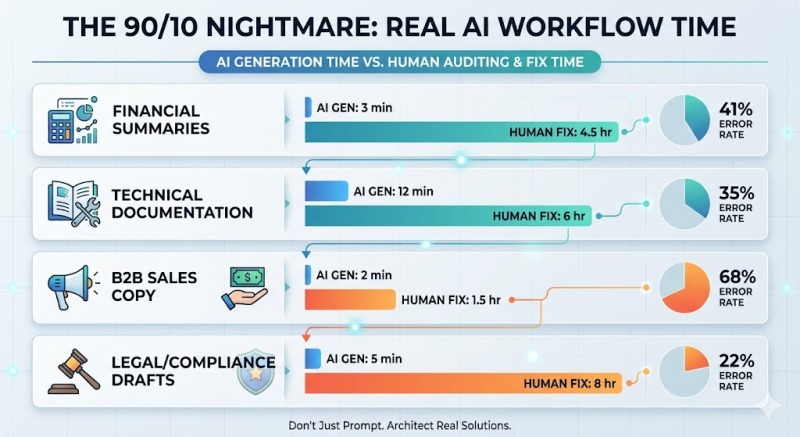
Instead of saving time, you spend double the hours meticulously checking the output because the system cannot be trusted entirely on its own.
You go from being a creator to a cynical editor trying to catch a machine in a lie.
The Unsexy Reality of Genuine Profit
I’ve seen the tutorials promising you can launch faceless channels or set up automated freelance gigs with zero friction.
The reality is just a bit more complicated.
If you try to launch generic copywriting services armed with nothing but an AI subscription, your offerings will drown in a sea of identical noise.
You cannot automate demand.
If a business concept is fundamentally flawed from the start, adding artificial intelligence just helps you fail faster.
If the hyped-up strategies are struggling, where is the actual leverage?
The folks pulling in real, sustainable revenue aren’t relying on magic prompts.
They are completely ignoring the hype and focusing on deeply unsexy, highly specific bottlenecks.
Think about the average concrete supplier, regional logistics company, or local HVAC contractor. They aren’t reading the latest tech papers.
In fact, recent industry surveys show that over 80% of construction firms still rely on manual Excel spreadsheets to handle critical project data.
And most small businesses are blowing up to 60% of their IT budgets just keeping outdated legacy systems from crashing.
The real financial victories come from bridging that exact gap.
Successful builders are creating highly tailored, invisible integrations.
They write bespoke scripts that turn a messy inbox into a functioning CRM.
They help local businesses cut overhead by generating basic assets for marketing.
It doesn’t need to be high art; it just needs to be functional, and the business owner saves thousands of dollars a quarter.
Surviving the Corporate Smoke and Mirrors
On the corporate side, the pressure is immense.
Executives are cramming generative features into everything, regardless of whether it brings actual value to the consumer.
For the workers left behind, the promise of a lighter workload hasn’t materialized.
The algorithms eliminate the repetitive data entry, but that means your entire day is now composed of exhausting, high-friction problem-solving.
You aren’t working less; you are working much harder on the things the machine can’t understand.
To escape this endless cycle of testing and discarding, you have to shift your mindset.
You must stop acting like a fascinated consumer and start acting like an architect.
Building a real business still requires a traditional, unforgiving format.
You have to find a genuine problem, validate a solution, and understand your buyer.
A machine can write your sales copy, but it cannot strategize your market entry or sit in a room and convince a skeptical client to trust you.
Don’t just generate random output because you can.
Go find a stagnant industry, identify a costly inefficiency, and build a quiet, unsexy system that actually solves it.
The gold is out there, but you won’t find it by just typing commands into a chat window.
You find it by getting your hands dirty and doing the boring, tough, manual work that actually introduces you to the real world.