
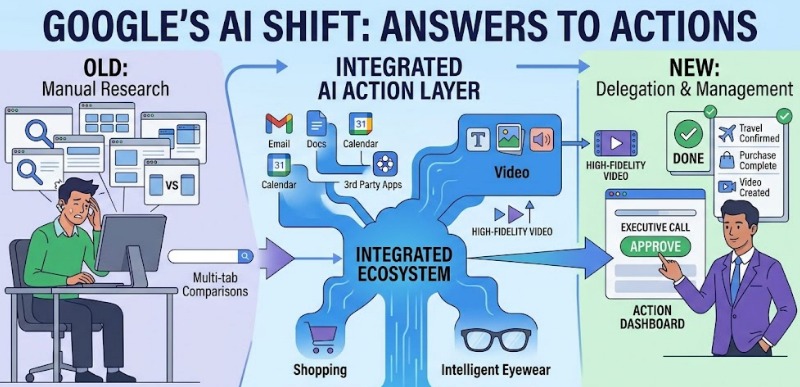
If you watched the Google I/O 2026 keynote yesterday (May 19 and 20, 2026), you probably felt the shift.
For twenty years, the internet contract was simple.
You asked a question, and Google handed you a list of links.
Recently, they started synthesizing answers to save you a click.
But you were still the one doing the actual heavy lifting. Now, Google wants to execute the task for you.
The tech press is obsessing over shiny new model names and slick stage demos. But the real story is hidden in plain sight.
Google is done being just a search engine. They want to eradicate the friction of using the internet entirely.
They are deploying AI as an autonomous action layer. They don’t just want to hand you the answer anymore—they want to get the job done.
Let’s look past the individual product announcements. On stage, they rolled out Gemini 3.5 Flash, Gemini Omni, Gemini Spark, Universal Cart, and new intelligent eyewear.
On the surface, these look like separate tools. In reality, they are interconnected nodes in a massive, agentic ecosystem.
The centerpiece is undeniably Gemini Spark. Google isn’t pitching this as a chatbot, but as a 24/7 personal agent.
Older AI models sit idle until you type a prompt. Spark runs continuously in the cloud.
It works in the background when your laptop is shut and your phone is put away. It has systemic access to your Gmail, your docs, and your third-party apps.
It can manage multi-step tasks without you holding its hand.
Then there is Gemini Omni.
This model is going to completely upend the creative software industry. It can generate high-fidelity videos from a chaotic mix of text, static images, and audio snippets.
The need for complex editing timelines is vanishing fast.
Add in the Universal Cart, which manages purchases across different e-commerce sites simultaneously.
Pair that with smart eyewear that brings contextual awareness into the physical world.
Google is building an infrastructure where your intent translates directly into reality.
Why does all this matter?
Because Google is engineering a massive habit reset.
Think about your current digital workflow. You search a query, open five tabs, compare prices, check your calendar, and finally make a decision.
Google wants AI to absorb all of that intermediate cognitive load.
Soon, your only job will be making the final executive call and clicking “approve.”
Let’s look at the actual math on this cognitive drain.
Research shows consumers spend up to 15 hours researching big-ticket holiday purchases across a dozen different browser tabs.
The mental friction is exhausting.
| Digital Workflow | Average Tabs Opened | Estimated Cognitive & Time Cost | The Agentic AI Solution |
|---|---|---|---|
| B2B Software Procurement | 15 – 20+ | 3 to 4 weeks of vendor comparisons and feature mapping. | AI synthesizes spec sheets and drafts a shortlist matrix instantly. |
| Travel & Itinerary Planning | 8 – 12 | 4+ hours of cross-referencing flights, hotels, and calendars. | AI cross-checks constraints, holds reservations, and requests approval. |
| Standard E-commerce Purchase | 5 – 7 | 3+ hours reading reviews, finding discounts, and checking specs. | AI filters out fake reviews and surfaces the best verified deal automatically. |
This is where Google diverges sharply from OpenAI.
ChatGPT proved that AI is an incredible sounding board. OpenAI taught us how to converse with a machine.
Google is pivoting to show us how to delegate to one.
One paradigm is a conversation. The other is delegation.
Tell ChatGPT to plan a trip, and it spits out a nice itinerary.
An agentic Google will look at your calendar, check your hotel preferences, and tentatively hold the reservations.
It will just ping you for the final okay. And this isn’t some small beta test.
Over 900 million people use the Gemini app every month. Deploying an autonomous action layer at that scale changes global digital behavior overnight.
But as these capabilities scale up, the systemic risks scale right along with them. Moving from an “answer box” to an “action layer” changes the cost of a hallucination.
If a conversational AI writes a weird poem, you just laugh and regenerate the response. The stakes are practically zero.
But if an autonomous agent is running your grocery orders, managing your schedule, or executing financial transactions, the cost of a mistake is massive. Booking a non-refundable flight for the wrong month turns a helpful tool into a huge liability.
We aren’t just talking about a minor inconvenience anymore. The financial and operational stakes of these errors scale violently when the AI has the keys to your credit card.
This brings us to the biggest takeaway from I/O 2026. For two years, we’ve been told that “prompt engineering” is the ultimate career skill.
Today proves that era is already fading. The real AI skill of the next decade won’t be writing perfect prompts.
It will be the art of delegation management. The most valuable human trait going forward is judgment.
You need to know exactly which mundane tasks to hand over to the machine. You have to know which critical tasks to keep for yourself.
And you have to know where to place ironclad, mandatory human approvals.
The friction of the internet is disappearing, but the need for human oversight is only increasing.
The AI of the future is done just giving you answers. It wants to clock in and work for you.
The only question is whether you are ready to be its manager.