
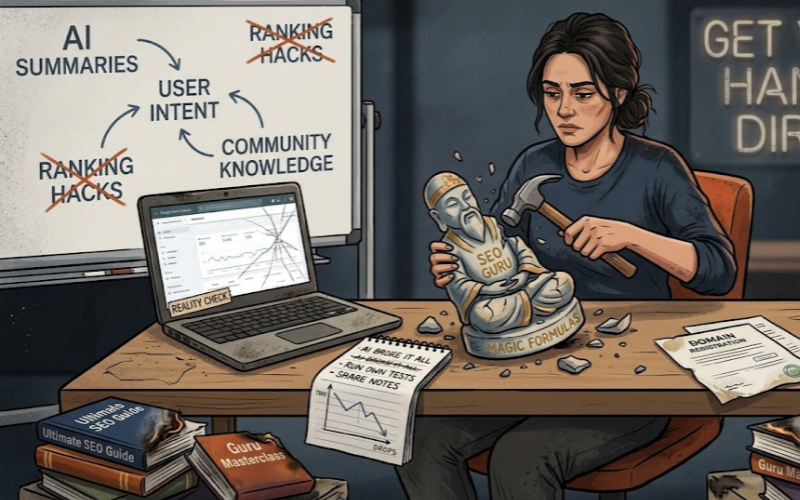
If you’re trying to figure out SEO right now, it feels like navigating a city where the streets get renamed every Tuesday. Artificial intelligence took the old search playbook, set it on fire, and laughed.
So if you just inherited the marketing for a small business, or you’re trying to get a side project off the ground, ignore the noise. The game isn’t about fighting for a blue link anymore. It’s about surviving the AI summaries and getting people to actually care.
Here is what you actually need to do:
Stop Buying the Guru Garbage
Let’s be honest about the elephant in the room: AI broke search, and nobody has it completely figured out yet.
The entire SEO industry is currently staring at their analytics dashboards, watching organic traffic evaporate, and sweating. Those “gurus” trying to sell you a course on how to perfectly hack AI Overviews? They’re guessing. They are scrambling in the dark to understand how large language models retrieve and summarize information, exactly like the rest of us.
There are no magic formulas right now. The old playbook burned down.
The biggest mistake you can make is freezing up and waiting for a self-proclaimed expert to hand you a shortcut.
Stop reading. Buy a domain. Build a messy site. Break things. Run your own tests. See what actually gets pulled into an AI summary and what gets ignored.
More importantly—share what you find. We are all back at square one. The people who are going to survive this shift are the ones tearing the engine apart in their garage and trading notes with each other. It’s about community and shared knowledge now, not top-down lectures from influencers.
Your own Search Console data will teach you the truth. The gurus are just trying to sell you their guesses.
Treat Search Like a Conversation, Not a Library
Most newbie marketers do the exact same lazy thing. They search a term, look at the top three results, and write a slightly longer, equally boring version of the exact same slop.
Why would an AI summary care about a carbon copy? Why would a human?
You have to bring something nobody else has. Lived experience. Real data. The scars of actually doing the work. If your page is just an echo of what’s already out there, you are dead in the water.
The Old Rules Are Dead
We used to care about raw volume. We used to stuff exact phrases into meta descriptions and pray.
Now? AI answers the question before the user even scrolls. Your job is to catch the clicks that slip through.
Instead of churning out a hundred random blog posts to see what sticks, build a handful of deep, connected answers to specific problems. Nobody cares about your ranking positions or pageviews if they don’t turn into actual money.
Here is a breakdown of how foundational concepts have evolved:
| Strategy Area | The Outdated Approach | The 2026 Reality |
| Primary Goal | Ranking #1 for ten blue links on a page. | Appearing in AI summaries and capturing high-intent clicks. |
| Content Creation | Publishing massive quantities of random blog posts to cast a wide net. | Building connected, highly intentional content clusters around specific problems. |
| Keyword Focus | Stuffing exact-match phrases into headings and meta descriptions. | Targeting semantic relevance, user intent, and natural language questions. |
| Success Metrics | Raw pageview volume and ranking positions. | Lead quality, actual conversions, and true user satisfaction. |
Stop Guessing What People Want
You used to be able to just look at a search results page to understand what people were looking for. Not anymore. Now you have to dig.
Dump a list of topics into ChatGPT or Perplexity. Ask the machine to figure out which ones are just people browsing, and which ones are people pulling out their credit cards.
Map out the questions people are actually asking. You might find out your audience is ready to buy five steps earlier than you thought.
If You’re Local, Stay Local
Running a plumbing business? A bakery? Ignore the global optimization noise.
Claim your Google Business Profile and squeeze every drop out of it. List every single service. Upload real photos of your actual team—not sterile stock images of people pointing at laptops.
And build a relentless system for getting reviews. Not just “Five stars, great job.” You want them saying, “Fixed the pipes in my Southside apartment in under an hour.” Specificity wins.
The Only Tools You Actually Need
You don’t need a $200-a-month enterprise software subscription.
Google Search Console is free and it’s the only truth that matters. Grab a cheap tool for finding gaps in your content. Keep an AI model open to test how the machines are answering things.
Use Ubersuggest or KeywordBuddy for keyword research. They’re low-cost alternatives to Ahrefs and Semrush, but they’re excellent entry-level platforms for finding semantic gaps and volume estimates without breaking the bank. Google Ads Keyword Planner is also a viable, free alternative.
That’s it.
The foundation hasn’t changed. Fix your broken links, make your site easy to navigate, and stop trying to trick the algorithm with cheap filler.
Solve a real problem. Build something useful.
The rest is just noise.