
I stumbled across a technical article the other day.
Google served it up right at the top of the search results, so I took the bait and clicked.
But reading it? That was an absolute slog.
I’m sure the writer knew their stuff. But the piece was so packed with tangled sentences and heavy jargon that I couldn’t follow a damn thing.
I immediately regretted wasting my time digging through search results.
I should have just gone straight to an AI.
So, I closed the tab, opened my favorite chatbot, and typed in the exact same question.
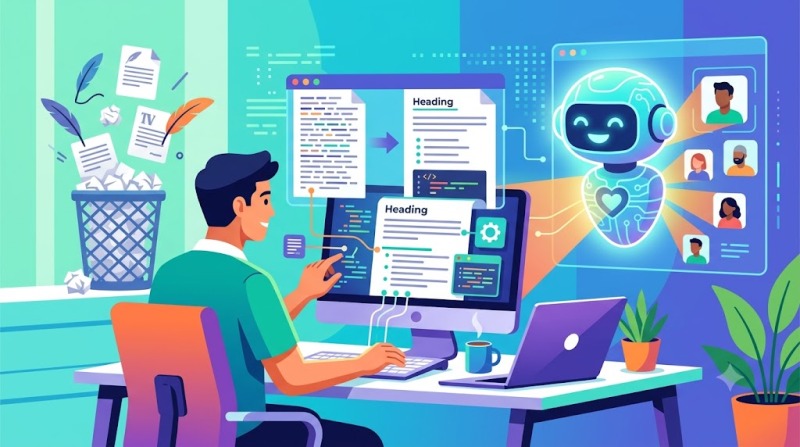
Within seconds, the machine broke the entire concept down for me.
Simple language. Clear formatting. It gave me an answer I could actually understand and use right away.
It felt like having a conversation with someone who genuinely wanted to help me figure things out.
That experience gnawed at me for the rest of the day.
It made me realize how frustrating the old way of looking for information has become when we have tools that can just cut through the noise.
So, I opened a blank document and started typing.
This is what came out.
Information isn’t a unique currency anymore. Perspective is.
To ensure you stay relevant, here are the three vital things you must understand:
1. Empathy is Your Unfair Advantage
It’s no longer about just sharing the data. Your unique perspective is the only thing keeping you relevant.
AI can spit out a flawless software feature document in three seconds. But it has zero user empathy. It doesn’t know why a specific UI quirk makes a user want to throw their laptop out the window.
When you write with empathy—when you acknowledge how frustrating a task actually is—you build trust. You actually reduce support tickets.
Injecting your voice pays the bills.
B2B articles with a real, human perspective generate three times more backlinks than generic SEO sludge. That’s exactly why companies are desperately updating their voice and tone guides.
You have to trust your human intuition. AI doesn’t have instincts. Clear thinking leads to clear writing.
The sooner you realize your perspective is your only life raft, the better your odds of surviving.
Bring your scars, your frustrations, and your honesty to the page. Because if you sound like a machine, you will be replaced by one.
2. Formatting is Your Lifeline
Because nobody is paying attention, you have to deliver the goods immediately. Search engines are already slapping AI summaries at the top of the page. Bury the lead, and both the robot and the human will skip right over it.
You need to put the conclusion at the very top. Give them the value proposition above the fold. Make it effortless.
Let’s look at the reality of how people read online:
- They only read about 28% of the words on a page.
- They scan in an F-shaped pattern.
- They are magnetically drawn to bold text. Numbers. Bullet points.
- People actually look at 70% of the bulleted lists they see.
So keep your text columns narrow. Under 15 words a line. Your formatting should never block the solution. It should be invisible.
3. The Conventional Intro is Dead
Remember the old days? We’d start a tech article with three paragraphs of throat-clearing. If you do that now, your reader is gone. Instantly.
Attention spans are shrinking. We’re competing with a million open tabs. The average internet user gives you about eight seconds. Less than a goldfish. Eye-tracking research proves it. People judge your page in ten seconds flat.
If they hit a massive wall of text, their brain shuts down. They bounce because they are constantly scanning for the next notification.
If your intro is full of fluff, you’ve already lost the battle. Stop telling them everything right out of the gate. Just give them what matters.
Final Thoughts
AI isn’t coming for technical writers. It’s coming for the boring ones.
For decades, a technical writer’s biggest asset was explaining complex things clearly. They were translators.
But the ground rules just shifted.
AI can already troubleshoot the equipment. It can review the tools. According to GitHub, over 92% of developers are already using AI coding assistants. They don’t need us to explain basic code anymore.
What they need is the messy, complex architectural context that machines completely miss. If you’re just dumping raw information onto a page, you’re going to lose.
Information isn’t a unique currency anymore. Perspective is.
AI is literally programmed to predict the next statistically average word. It is designed to be conventional. To survive this shift, you have to break the mold.