
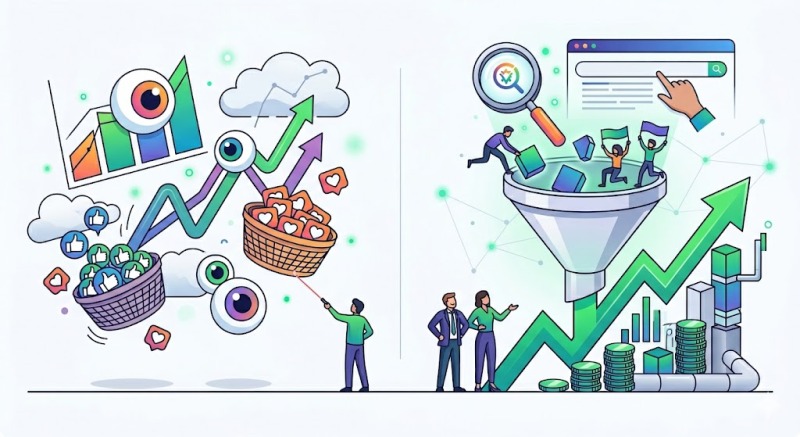
We all know exactly how the game is played. When the leads dry up on a performance campaign, the budget gets cut immediately. But when an awareness campaign tanks, we suddenly start talking about “reach” and call it a long-term play.
It is the oldest, laziest trick in the marketing playbook.
We’ve abused the phrase “brand building” for a decade. It’s a protective shield against accountability used by people who don’t actually know how to close a sale.
If you run a bootstrapped SaaS or a local shop, paying for empty clicks is a death sentence.
You have to bridge the gap between abstract recognition and actual business outcomes. Everything else is just expensive noise.
Stop Optimizing for Eyeballs. Measure the Action.
Let’s say you have a viral TikTok post. The algorithm blesses you. A hundred thousand views. Your dashboard turns green.
But if you can’t intentionally reproduce that outcome, and if those viewers never enter your ecosystem, that spike means nothing.
It’s a random glitch, not a scalable growth lever.
Actionable metrics measure deliberate behavior.
When someone searches for your company name, that’s high intent. They bypassed generic discovery. They actively sought you out.
That is the purest distillation of mental real estate. They remembered who you are and tracked you down.
Instead of staring at social media followers, look at your active community contributors. A million passive followers mean absolutely nothing to your bottom line.
Ten people defending your product in a Reddit thread drive actual conversions.
Stop celebrating total pageviews and start isolating branded organic clicks. High traffic from a random viral blog post rarely converts.
Users searching your specific name convert at exponentially higher rates because they know exactly what they want.
Forget ad impressions. Measure direct traffic volume. An impression simply means an ad loaded on a screen—maybe while someone was looking the other way.
Direct traffic means the user memorized your URL and typed the address into their browser.
Ignore the raw email list size and obsess over reply and click-through rates. A massive list of dormant addresses is just an expensive liability.
Measuring who actually clicks your links tells you who actually gives a damn about your message.
And when PR agencies claim a “potential reach” of 50 million readers? Laugh them out of the room.
Real traction is measured by earned backlinks and mentions from niche blogs linking back voluntarily.
If you can’t connect a metric to a specific action—tweaking a landing page, adjusting ad spend, pivoting a content strategy—throw it in the trash bin.
Unlocking Google Search Console’s Branded Queries Filter
For years, tracking branded search meant exporting massive CSV files from Google Search Console. You had to run complex regex formulas to filter out misspellings, product variations, and generic terms.
It was tedious. It was prone to human error. And it was completely inaccessible for beginners.
That changed recently. Search Console launched a native, AI-powered branded queries filter inside the Performance report.
It completely revolutionized how we track organic lift.
How the AI Filter Changes the Game
Branded queries filter automatically groups queries containing your company name, common misspellings, and specific proprietary product names. It splits your traffic into two buckets:
- Branded: Users who already know you exist. They are typing your name directly into the search bar.
- Non-Branded: Users trying to solve a problem without a specific vendor in mind. (Think “best email marketing software” instead of “Mailchimp”.)
This gives you a stark, honest look at your organic footprint. If your site gets 85 percent of its clicks from branded searches, your content optimization is failing.
You are only capturing returning customers or people who heard about you elsewhere. To net-new prospects, you are invisible.
On the flip side, if your traffic is 95 percent non-branded, you might have stellar informational blogs, but nobody remembers your name when they leave. They get their answer and bounce.
Measuring the Lift of Top-of-Funnel Campaigns
Let’s say you launch a heavy awareness push. A podcast tour. A targeted YouTube sprint. A massive community engagement effort. How do you prove it worked?
You establish a baseline in GSC for your branded clicks and impressions over the prior ninety days. After the campaign goes live, monitor that specific filtered cohort.
If the campaign actually penetrated the market, you will see a measurable spike in branded impressions. People heard the podcast. They remembered the name. They Googled you three days later.
Here is a hypothetical look at a three-month top-of-funnel campaign. Watch how the click-through rate (CTR) on branded terms behaves compared to generic searches.
- Month A (The Baseline): Before any active campaigns run, you record 450,000 non-branded impressions sitting at a standard 1.2 percent CTR. Meanwhile, your branded impressions are tiny—just 5,500—but they command a massive 42.1 percent CTR.
- Month B (The Launch): Your podcast tour begins and PR pushes hit the wire. Non-branded metrics barely move (465,000 at 1.1 percent). But your branded impressions immediately jump to 8,200 with a 45.3 percent CTR. People are hearing your name and looking you up.
- Month C (The Escalation): You start running YouTube bumper ads heavily. Generic search stays flat (460,000 at 1.3 percent), but your branded footprint explodes to 14,800 impressions at a 48.6 percent CTR.
- Month D (The Residual Lift): The campaigns end and you monitor the aftermath. Non-branded traffic is sitting right where it started (475,000 at 1.2 percent).
As those numbers show, non-branded metrics stayed relatively flat the entire time. But branded impressions nearly tripled by Month D, maintaining an exceptionally high CTR. Users searching for a specific entity are highly motivated.
By isolating these numbers, you can explicitly prove to executives that the podcast tour drove 11,000 net-new, highly qualified searches.
Mapping Macro-Trends with Google Trends
GSC is phenomenal, but it has a blind spot. It only reports searches where your website actually appeared in the results.
If a thousand people search for your startup, but your SEO is lacking and you fail to rank on page one, GSC won’t record those impressions.
To gauge absolute market curiosity, you have to pair GSC with Google Trends.
Trends acts as a proxy for raw cultural penetration. It normalizes search interest on a scale from zero to a hundred.
For bootstrapped companies, absolute search numbers might be too small for Trends to register right away. But once you hit a certain threshold of visibility, it becomes an invaluable comparative tool.
The Competitor Benchmark Strategy
Looking at your own curve in isolation is dangerous. A seasonal spike might trick you into thinking a recent ad launch was a massive win.
In reality, the whole industry just experienced a seasonal surge.
The real power of Trends lies in competitive benchmarking. Input your company name alongside three direct competitors.
- Scenario A: Your interest score jumps from ten to forty in November. But your top competitor jumps from twenty to eighty during the exact same window. Your marketing didn’t succeed. You just rode an industry wave, and your competitor captured a larger share of it than you did.
- Scenario B: The industry average stays completely flat, but your specific curve steadily climbs month over month. This is the holy grail. You are stealing market share. You are capturing top-of-mind real estate from rival firms.
Export this comparative index. Lay the curve over your revenue growth charts.
When the CEO asks why demand generation needs funding, point to the graph showing your chief competitor dominating the cultural conversation.
Fear of missing out is a powerful motivator in the boardroom.
Scraping the Chatter with F5Bot and Forumscout
Search algorithms are evolving. Traditional search engines are heavily integrating Large Language Models (LLMs).
We are shifting from Search Engine Optimization (SEO) to Answer Engine Optimization (AEO).
If you want an AI like ChatGPT, Claude, or Perplexity to recommend your SaaS product, you can’t just stuff keywords onto a landing page.
These models are trained on human consensus. And where does human consensus live? Forums.
Studies show that Reddit is the highest-cited source across major AI platforms. It beats Wikipedia. It beats YouTube. It beats traditional news outlets.
If your name isn’t being mentioned organically in niche subreddits, the AI models don’t know you exist. They will never recommend you.
Enter F5Bot: The Bootstrapper’s Best Friend
Enterprise listening software like Meltwater or Sprinklr is incredibly powerful. It tracks sentiment across global news, podcasts, and social feeds.
It also costs upwards of five thousand dollars a month. That price tag is completely detached from reality for a solo developer or a small marketing team.
Instead, turn to F5Bot. It’s a completely free tool that emails you the exact moment a specific keyword drops on Reddit, Hacker News, or other tech-centric boards.
Set up F5Bot tracking for three distinct categories:
- Your specific product name: Catch customer complaints, praises, or support questions instantly.
- Your competitors’ names: Find frustrated users complaining about a rival service. This is prime territory to step in with a helpful alternative.
- High-intent industry phrases: Terms like “alternatives to [Big Player]” or “how to automate [Specific Task].”
When that email alert hits your inbox, do not just spam a link to your homepage. That guarantees a ban from moderators.
Enter the thread. Provide genuine, authoritative advice. Then organically mention how your tool solves their exact headache.
Scaling Up with Forumscout
As you scale, relying solely on email alerts becomes chaotic. The noise-to-signal ratio shifts.
You start getting pinged for irrelevant conversations that happen to share a word with your product.
This is where an affordable platform like Forumscout comes in. It strips away the bloated scheduling and inbox-management of enterprise suites. It focuses entirely on scraping insights from communities.
Automation
For technical marketers, you can route these alerts into advanced workflows:
- F5Bot detects a keyword on a niche subreddit.
- A webhook sends the post to an automation platform like n8n.
- An LLM analyzes the subreddit’s specific rules regarding self-promotion.
- If promotion is allowed, the LLM drafts a highly contextual, casual response—avoiding corporate buzzwords—and drops the text into a spreadsheet for your manual approval.
This workflow bridges the gap between passive tracking and active community infiltration. You aren’t just measuring the chatter. You are shaping it.
As your team drops helpful, upvoted comments across these boards, those threads get indexed by LLMs. Six months later, when a user asks ChatGPT for the best software in your category, the AI regurgitates the exact consensus you helped build.
Moving Beyond the Dashboard
The digital landscape is obsessed with immediate gratification. Put a dollar into a Meta ad, the dashboard needs to show three dollars coming out twenty-four hours later.
This obsession with direct-response metrics has gutted long-term brand equity. Companies are optimizing themselves into irrelevance by hyper-focusing on the bottom three percent of the funnel: the users who already hold their credit cards.
The remaining ninety-seven percent of the market isn’t ready to buy today. They are researching. Asking peers for recommendations. Lurking on subreddits. Reading technical teardowns.
If you abandon awareness campaigns because the ROI is difficult to map, you forfeit tomorrow’s pipeline.
Building a Credible Attribution Narrative
To win the internal battle for resources, you have to connect these disparate tools into a cohesive story.
- The Leading Indicator: Use F5Bot and Forumscout to demonstrate an increase in organic mentions and positive community sentiment. Show management screenshots of real humans recommending your solution over a competitor.
- The Mid-Funnel Validation: Pull the comparative curves from Google Trends. Prove that community chatter is translating into broader cultural curiosity. Show the gap closing between you and the market leader.
- The Concrete Proof: Open Google Search Console. Filter for branded queries. Point to the exact percentage lift in people typing your name into the search bar. Show how the click-through rate on those specific queries dwarfs every other channel.
Present these three layers of evidence. You are no longer asking executives to blindly trust the magic of brand. You are presenting a mathematical chain of events.
Community engagement drives curiosity. Curiosity drives targeted search behavior. Targeted search behavior drives the highest-converting traffic on the internet.
Final Thoughts on Sustainable Growth
We have to stop treating top-of-funnel marketing as some unquantifiable aura. It is simply the aggregate sum of what the public believes about your business.
And that belief is highly trackable if you know where to look.
Stop obsessing over how many people scrolled past a sponsored post in their feed. That metric is fundamentally broken. A view is not an endorsement. A like is not a sale.
Pivot your energy to capturing high-intent signals.
A frustrated sysadmin posts on a forum at midnight asking for a solution, and three independent users reply with your company’s name. That is equity. That same sysadmin bypasses generic software lists the next morning and Googles your exact URL. That is equity.
Leverage the precise tracking of GSC, the macro-view of Trends, and the grassroots listening power of tools like F5Bot.
Prove that top-of-funnel marketing is never an expense. It is an investment bringing a highly measurable, undeniable return.
Drop the vanity statistics. Measure the intent. Build the pipeline.
Make sure every marketing dollar is accountable to reality. That is how you stop defending your budget and start scaling your growth.
Developing Your Own Measurement Routine
If you want to implement this philosophy tomorrow, follow this weekly checklist:
- Monday: Review GSC Branded Queries. Note any sudden spikes or dips. Did a weekend PR hit result in sustained search traffic? Document the percentage of branded versus generic clicks.
- Wednesday: Analyze the F5Bot digest. Are competitors launching features that frustrate their user base? Log those complaints into a repository for your product team. Drop into active threads and provide neutral, helpful insights.
- Friday: Check Google Trends against your benchmarked rivals. Update your internal tracking grids. Look for seasonal patterns or shifting momentum.
Discipline is the deciding factor. Consistency in tracking the proper metrics will always outperform sporadic obsession over the wrong ones.
Keep your focus strictly on intent. The revenue will follow.