
Think back to the last time you searched for a simple error code. Or how to fix a leaky faucet.
For a solid decade, you rarely got a straight answer. You got a 2,500-word wall of marketing garbage, written by a robot, optimized by a “guru,” and designed to keep you scrolling past five different pop-up ads.
Search broke. The organic web rotted.
Today, the bleeding has finally started to stop. You might actually see a AI-generated summary at the top of your screen that hands you the exact fix, saving you from the slog.
But peek right below that AI overview. The wreckage is still there. And let’s be brutally honest about who actually caused that mess. We did.
For years, SEOs, marketers, and “content writers” treated the internet like a dumping ground. We manipulated rankings purely in the name of “optimization.” We prioritized hitting an arbitrary keyword ratio over giving the end user a decent experience.
It was inevitable that the search engines had to come up with a better plan. Google didn’t just change the rules every few months to torture us — they were desperately trying to combat an endless wave of our SEO spam.
It was a decade-long game of whack-a-mole. We’d find a loophole, and they’d drop an algorithm update to patch it.
Then they finally dropped the hammer with AI overviews. Google got tired of the game. Instead of forcing users to wade through our 3,000-word walls of filler, they built a machine to bypass the fluff entirely.
Now, a user actually has a real chance to get the exact answer they need, right there on the search results page, without having to dig through our bloated marketing funnels.
Let’s Talk About Chocolate Chip Cookies
You know exactly what I mean.
You want a recipe. You don’t get a list of ingredients. You get a sprawling essay about the author’s childhood summers in upstate New York, followed by a philosophical breakdown of “What is a Cookie?”
You have to scroll until your finger goes numb just to find out how much flour you need.
This didn’t happen by accident. It happened because SEOs figured out the algorithm rewarded time-on-page and lengthy content.
We practically forced writers at gunpoint to strip the life out of their work, turning simple instructions into a keyword-stuffed nightmare just to manipulate the rankings.
The same goes for technical help. You get a blue screen crash. You search the exact error code. Instead of the one line of code you need, you get an automated tech forum telling you to reboot your machine, followed by a pitch for a $40 registry cleaner.
We made the web so miserable that people now aggressively append “Reddit” to the end of every search query just to find real human conversations.
The “Expert” Epidemic and Snake Oil Salesmen
The industry responsible for this mess suffers from a catastrophic lack of entry barriers.
Anyone who has skimmed a single digital marketing tutorial, installed a basic plugin, and looked at an analytics dashboard suddenly crowns themselves a “Guru”.
These self-proclaimed wizards are actively hurting small businesses. A local business owner, desperate for online visibility, hires one of these charlatans who might charge an exorbitant $10,000 flat fee per keyword.
They outsource the writing to overseas content mills or focus entirely on vanity metrics—buying toxic links from expired domains, manipulating numbers on a spreadsheet, and presenting meaningless graphs.
These agencies operate on a model of exploiting ignorance. They slap their logos on automated, generic site audits generated by free software and pass them off as authentic, intensive manual labor.
When the business owner inevitably asks why their phone is not ringing, the agency deflects, blaming mysterious algorithm updates.
It is a systemic grift, a race to the bottom where the cheapest, most unethical tactics are weaponized.
The AI Escalation
We were already making the internet unreadable. But the real change happened with the emergence of AI.
Suddenly, the “gurus” — the guys who used to charge small businesses $5,000 to outsource garbage content to overseas mills — got their hands on generative language models. They deployed automated scripts to pump out generic slop at a terrifying scale.
A tsunami of regurgitation, spinning the exact same five facts into infinity.
And now? It is no wonder that Google is utilizing AI to combat this exact situation.
They have to. The search monopoly is deploying artificial intelligence to nuke the very spam that AI created.
It’s machines fighting machines, attempting to filter out the automated grifters, the link spammers, and the content assembly lines.
The Content Assembly Line
Writing for the web used to be an act of communication. Now, it is an exercise in robotic compliance.
Tools designed to monitor search volumes now completely dictate the editorial calendar. A writer does not sit down to answer a burning question they heard from a customer.
Instead, they log into a dashboard, pick topics straight from the software based on “low difficulty” metrics, and mechanically assemble a document.
These posts feel entirely dead. They lack a soul, an opinion, or a unique perspective. When you read them, you can clearly sense that the article only exists because a software metric commanded its creation.
Every paragraph is structured identically: a keyword-heavy heading, a bulleted list to capture a snippet, and aggressively forced internal links that point the reader in six different directions simultaneously.
The structure of these articles destroys the flow of reading. You cannot get through a single argument without being interrupted. The writing becomes flat, predictable, and devoid of the author’s natural voice.
In the pursuit of technical perfection, the human element is completely eradicated.
The Human Approach vs. The SEO Assembly Line
If you want to know why the internet feels empty, look at how the work gets done now.
The Idea
- The Human Approach: Topics come from actual customer struggles, sales calls, and real forum debates.
- The SEO Assembly Line: Topics are exported from a difficulty-scoring spreadsheet. Nobody actually cares about them.
The Flow
- The Human Approach: Headings guide you naturally through a story or an argument.
- The SEO Assembly Line: Headings read like a rigid checklist driven by keywords.
The Polish
- The Human Approach: You edit to protect your voice, keep the weird anecdotes, and make sure your personality bleeds through.
- The SEO Assembly Line: You edit to verify templates and file down any real opinions into generic “helpfulness.”
Reclaiming Your Voice
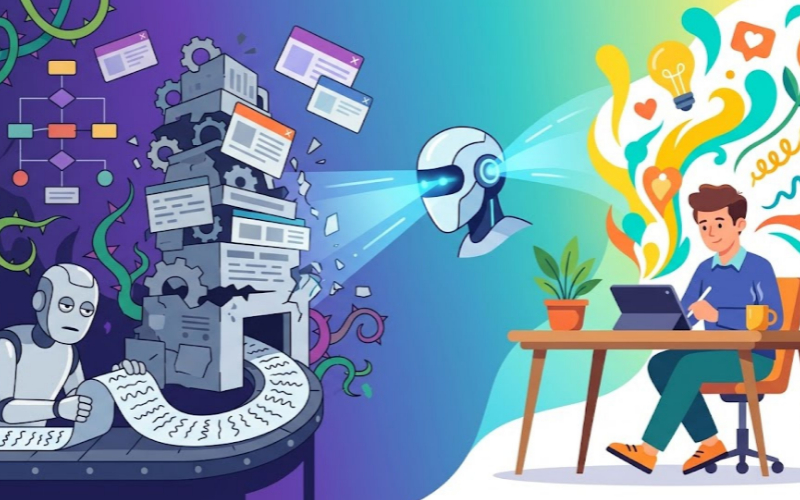
The internet used to be a messy, chaotic frontier. We paved it over with optimized templates and robotic compliance. Now the bots are taking over the paving.
Behind the scenes, the professionals trying to do this right are exhausted. You sit in Friday progress meetings trying to explain to a client that you can’t just hack your way to the top anymore. You have to actually be good.
So what do we do?
We stop treating web pages like mathematical equations. We abandon the templates that drain the blood from our writing.
If you have a strong opinion, an awkward anecdote, or a controversial stance — leave it in the text. The messy parts are exactly what prove a human being is sitting behind the keyboard.
The web is suffocating under its own optimization. You don’t beat the machine by trying to out-robot it. The search engines are already using AI to hunt down the fakes.
Stop optimizing the soul out of your work. Write like a human. It’s the only edge you have left.