
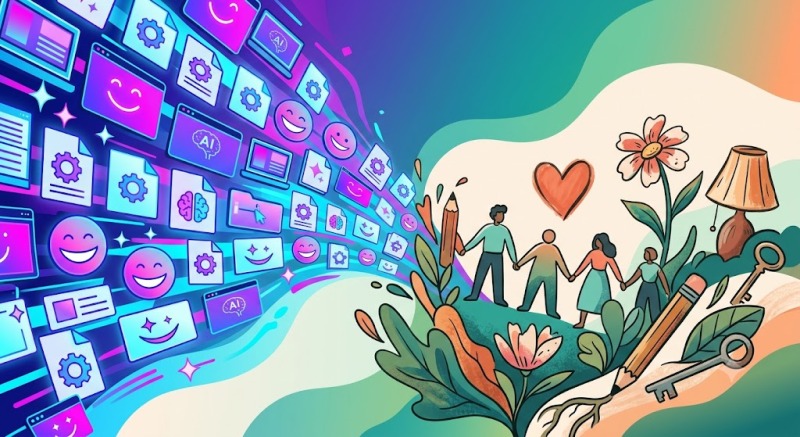
The internet is basically choking on synthetic slop in 2026.
It’s super cheap. It’s effortless. And it’s completely wrecked the real value of average content.
People are now just starving for genuine human connection because they’re suffocating under a mountain of “AI-generated perfection”.
Researchers are calling it the Authenticity Paradox.
Here is exactly how this dual, contradicting effect has rewired the content landscape and what audiences actually expect from us now.
The Content Landscape: Hyperscale vs. Devaluation
These days, you can basically spin up a thousand blog posts for pennies.
You can generate hyper-personalized videos in a fraction of the time traditional production takes.
Brands are operating at hyperscale. The marginal cost of content creation has hit zero.
But here is the catch. Hyperscale fundamentally devalues the medium.
When you flood the channels with flawless, synthetic perfection, the truth economy collapses.
Producing plausible content costs nothing. Verifying if that content is real costs everything. We have entered a post-veridical state, and society is struggling to keep up.
Audience Expectations: The Authenticity Paradox
People aren’t stupid. They have developed a sixth sense for artificial perfection.
They see the glossy polish and immediately swipe past it. It feels unsettling. It lacks blood. It lacks texture.
This triggers the Authenticity Paradox. The more AI floods the feed, the more desperately consumers search for humans.
They want the unpolished, messy, lived experiences that a machine cannot fake.
Human creators are outperforming AI in emotionally driven sectors simply because they embody flaws. AI cannot replicate a scar or a bad day.
Audiences don’t hate AI. They just have strict conditions for it.
They welcome the machine when it acts as a silent utility. We like it when AI recommends a good movie, fixes a backend glitch, or improves video quality.
But when it pretends to be human? We reject it. Hard.
A 2026 survey by Hub Entertainment Research found that 30% of consumers love AI for backend stuff.
But a massive 60% are terrified of losing their grip on reality. They worry about deepfakes, stolen likenesses, and unverified garbage.
It gets worse for brands. If a regular person uses AI to fix a typo, nobody cares. About 40% of people are fine with that.
But if a brand or influencer uses AI to fake a personality and print money, the trust vanishes. Acceptance plummets to roughly 20%.
The New Baseline: Absolute Transparency
You can’t hide the machine anymore.
In the past, agencies loved to pretend their automated funnels were bespoke services. Try that now and watch your brand burn.
Nearly 90% of consumers demand explicit disclosure when AI plays a role in creating content.
Transparency isn’t a perk. It is the absolute baseline expectation. If you try to pass off a bot as a human worker, the backlash will erase your brand equity overnight.
The Micro-Influencer Shift
The mega-influencer era is undergoing a massive structural correction too.
Brands are pulling their budgets from celebrities and handing them to micro-influencers and nano-creators.
It comes down to the physics of trust. As an audience gets massive, the intimacy stretches too thin.
A creator with 5,000 highly engaged followers beats a celebrity with 5 million passive scrollers. Smaller communities deliver vastly superior conversion rates and cost-efficiency.
Massive follower counts used to be the gold standard. Today, algorithms reward relevance and depth.
Nano-influencers consistently hit engagement rates of 3.5% to 8%, peaking near 12% on TikTok. Macro accounts are barely scraping 1.5%.
People trust peers. They ignore polished celebrity endorsements because they smell exactly like traditional commercials.
Then you have to look at the unit economics. You can hire a network of twenty micro-creators for the price of one massive hero post.
It de-risks the campaign. It spreads the budget.
According to Idiotic Media, micro-influencers deliver twice the views and three times the engagement for the exact same budget. You pay pennies per view compared to macro campaigns.
It floods the zone with localized, simultaneous spikes in traffic. It creates a cultural wave that algorithms heavily prioritize.
Brands are abandoning the one-and-done sponsored post. They want long-term ambassador programs. Repeated exposure from a smaller creator shifts the perception from a paid ad to genuine advocacy.
The Shift in Consumer Behavior
The constant barrage of digital noise has really created massive digital fatigue for consumers.
Buyers actively filter out generic advertising by default. Marketers cannot just shout into a megaphone and expect sales.
One-way broadcasting is dead. People don’t trust corporate claims.
They trust social proof. They trust electronic word-of-mouth.
Over 84% of buyers rely on peer posts and real-time online reviews just as much as personal recommendations from friends.
They want a two-way street. They expect to comment, ask questions, and interact in real-time.
Traditional ads—the television commercials, the billboards, the print flyers—are losing their edge. Massive reach no longer guarantees conversion. Targeted, organic conversations are winning the war for attention.
The Interest Graph vs. The Social Graph
There was a time when follower counts used to act as the ultimate ceiling for your reach. You owned your audience on platforms like Facebook and early Instagram.
That system has been dismantled.
The short-form video revolution killed the Social Graph and replaced it with the Interest Graph.
It is a ruthless meritocracy based entirely on immediate watchability. You don’t own distribution anymore. You rent it per post.
A brand with a million followers can post a boring video and get buried. A nobody with zero followers can post something incredible and reach millions overnight.
An estimated 68% of impressions on TikTok now come from non-followers.
It all comes down to completion rates and watch time. The algorithm tests your video on a tiny group. If they swipe away in the first three seconds, your reach dies instantly.
You need a 70% completion rate just to break out into the viral tiers. Hook them fast or go home.
Instagram is running a split personality to handle this. Reels act as the discovery engine for strangers on the Interest Graph. Carousels act as the relationship builder for your current fans on the Social Graph.
You have to master both to survive.
Privacy and The Value Exchange
The days of tracking people in the shadows are done as well.
Strict privacy laws, automated opt-outs, and default browser blocking have smashed the third-party cookie infrastructure.
You have to ask people to step into the light.
First-party and zero-party data are the ultimate competitive moat. Information gathered directly from your website. Preferences handed over willingly by your customers.
This data is real. It is deterministic. It is privacy-compliant.
Brands leaning into first-party data are seeing massive revenue lifts. It slashes customer acquisition costs by up to 83%.
But you have to earn it.
Enter the Value Exchange. Data is currency. You must offer real, tangible value if you expect someone to hand over their personal information.
Give them a discount. Give them free shipping. Upgrade them to a VIP tier. Save them time with personalized recommendations.
Stop tracking in secret. Build transparent relationships.
Consumers express significantly higher trust in companies that rely entirely on transparent data relationships.
The companies investing in Customer Data Platforms and privacy-by-design are the ones who will still be standing when the dust finally settles.
Final Thoughts
The digital ecosystem hasn’t just evolved; it has fundamentally inverted.
We spent the last decade building machines to mimic human interaction at scale, only to realize that scale is exactly what destroys intimacy.
As AI drives the marginal cost of content creation to zero, it simultaneously drives the premium on trust to an all-time high.
The brands and creators who survive this paradigm shift will not be the ones who try to out-compute the algorithms. They will be the ones who learn to out-human the machine.
To thrive in this post-veridical era, the new playbook is non-negotiable:
- Stop polishing the humanity out of your brand. Synthetic perfection is now a red flag. Lived experience, messy texture, and genuine vulnerability are your strongest assets.
- Influence is no longer about shouting the loudest; it’s about speaking the most directly. Trust lives in the trenches with nano- and micro-creators, not in the sanitized feeds of mega-celebrities.
- The Interest Graph dictates that you must earn your audience’s attention from scratch with every single post. Use that rented, merit-based reach to drive users into transparent, first-party data relationships built on a genuine Value Exchange.
- Never disguise a bot as a human. Treat transparency not as a tedious legal obligation, but as the foundational pillar of your brand equity.